AI Agent2026
Are You The One
A Qloo hackathon agent: say what you're making and where, it finds what that city loves and isn't getting, and an LLM writes your film, reel or drop into it.
- Type
- Hackathon project (Qloo Agentic Hackathon)
- Year
- 2026
- Platform
- Web app · MCP server
- Role
- Sole author
- Collaboration
- Solo, written with Claude Code
- Timeline
- Oct 2026 (27 — 31 Oct)
- Stack
- Node.js · Express · Qloo API · Claude · OpenAI Images · three.js · Docker
The problem
Anyone who makes something for a place starts from a blank page and a guess: a short-film maker, a reel creator, a small clothing label, a café. A filmmaker in London knows crime travels. Nobody can tell them which kind of crime story London loves and isn't getting, and the audience research a producer can buy mostly tests what already exists, after it has been announced.
Qloo's taste data knows what a city's people like. AYTO (Are You The One) uses it to find what they like and aren't being given, and writes the idea into that gap.
What it does
You type one sentence: "I'm making a crime short film in London." Then it works in stages, each one streamed to the page as it finishes:
- Resolves the city as a Qloo locality, the theme as Qloo tags and any titles you named, and shows you what it found before anything runs.
- Reads the city against the country and against three control cities of similar size, for the same theme.
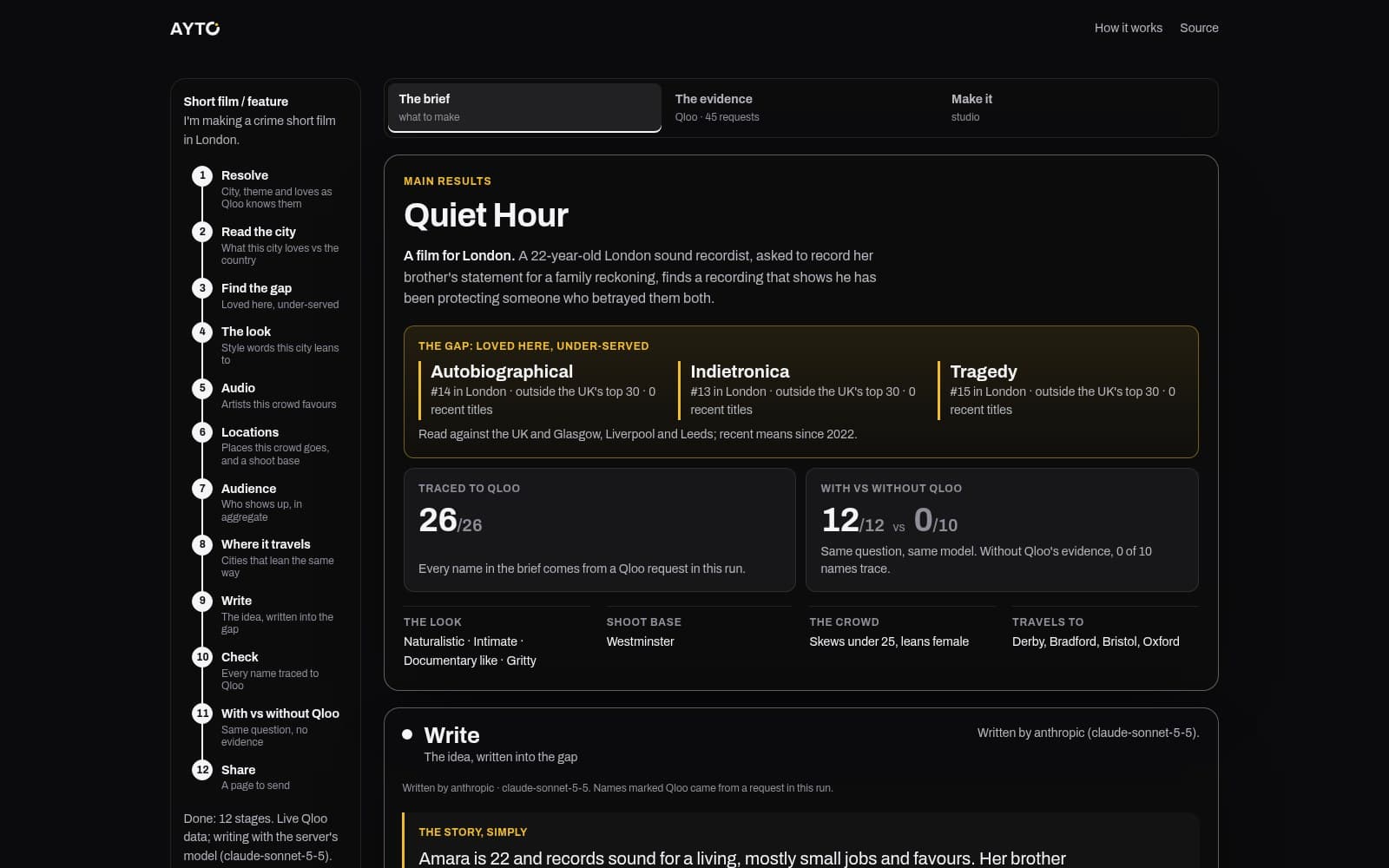
- Finds the gap: flavours the city ranks far above the country and above the controls, then counts how many recent titles in the city's own themed catalogue carry each one.
- Reads the rest: the look the crowd leans to, the artists and places it favours, the audience, and the cities whose taste leans the same way.
- Writes into the widest lane with a language model: Claude Sonnet 5.5 on the live site, or any of twelve providers with your own key, which never leaves memory.
- Checks itself, and proves Qloo is the difference (below).
The same engine writes eight formats: a film treatment, a reel, a fashion drop with styles you can turn in 3D, a podcast, an indie game, a café, a live night and a book. It is also an MCP server, so another agent can ask it where to make something and get lanes back with their receipts.
The gap, measured
For London, the lanes were Autobiographical, Indietronica and Tragedy. London ranks each in its top 15; the UK doesn't rank them in its top 30; and Glasgow, Liverpool and Leeds, taken together, don't share the lean. Then the supply read: zero recent titles in the catalogue carry them. Loved here, under-served.
The control cities are there because the first version was fooled. A country baseline behaves like its largest city, so a flavour that every big city loves looks like a local gap when you only compare a city with its country. A lane now has to beat the country and the controls, and it is ranked on the smaller of the two lifts.
Proof it isn't the model talking
Every name in the written brief is looked up in what Qloo returned during that run. Anything the model made up is removed, and the writer tries once more with those names banned. Each name on the page opens the Qloo request it came from; the London run makes 45 of them.
Then the same model gets the same question with no Qloo evidence, and AYTO counts how many of its names trace to anything. In the run on the cover, with Qloo, 12 of 12 traced. Without it, 0 of 10: the model reached for the London crime films everyone already knows (Layer Cake, Top Boy, The Long Good Friday), where the Qloo-backed brief studied Queen & Slim, The Good Liar and The Hate U Give. That card is the project's argument: without the taste data, you get the obvious answer.
The API pushed back
Most of the four days went into the data, not the prompts.
- Signalling a tag with a location lets the location win. "Crime" signalled with a city returned Borat. The theme had to be a filter, not a signal.
- Affinity is flat at the top, 0.98 to 1.00, so ranking by it is noise. AYTO ranks by set differences between city and country, and by affinity minus popularity.
- The API fails quietly. "Mumbai, India" returns zero artists without an error, while the state-qualified name works. Tags are typed: of twelve hip hop tags, three filter artists, one of them named " Hip Hop" with a leading space.
- An original and its remake share an alias, and the describe tool picks the remake. Resolution now ranks search results by year, by "remake of" in the description and by the city's language, and the confirm step shows the options.
- A café lane once came back as a religious group. People-group tags look like flavours to the maths, so they are now filtered out of lanes entirely.
How it is checked
- 170 tests, including every showcase run end to end on synthetic data, the writers fed broken model replies (code fences, cut-off JSON, the wrong shape), and the result panel built from each showcase.
- A bug hunt before the deploy that reproduced and fixed about 90 bugs.
- A security pass on the live site: rate limits keyed on the real visitor, daily caps on every paid call, security headers, and user keys kept in memory for one run and redacted from errors.
- It fits a free host. At 0.1 CPU and 512 MB with an empty cache, all three showcases finish within about 85 seconds of a cold start.
What it does not prove
Qloo describes aggregate taste, not sales, so a lane is a signal that a city leans somewhere, not a forecast that a film will do well. Supply is counted in the themed catalogue Qloo returns for the city, about fifty titles, not in a market's full release slate. The written brief is a language model's work on top of that read, and its quality varies from run to run; the check guarantees where its names came from, not that the idea is good. What the project does show is that the same model, asked the same question, gives a measurably different and checkable answer when it is grounded in a city's taste.